In addition to trading on commodities like oil futures and livestock options, investors now have a new commodity to trade: The futures of college grads.
23-year-old higher education recruiter Amy Wroblewski caught Bloomberg’s attention this week in a report on so-called “income-sharing agreements” between investors and college grads. Wroblewski, who has a working-class background and earns a modest salary of $50,000/year, pays investors $279 of her monthly salary.
If she makes more in her professional career, Wroblewski is expected to pay a larger portion of her income. And if she loses her job, she no longer pays, and investors have to wait to collect their money until she gets another job. Under her arrangement, she’ll be on the hook to investors for more than eight years. Students who take on riskier majors that tend to result in lower-paying jobs have to pay a higher percentage of their monthly salaries, and students with more lucrative majors pay a smaller percentage.
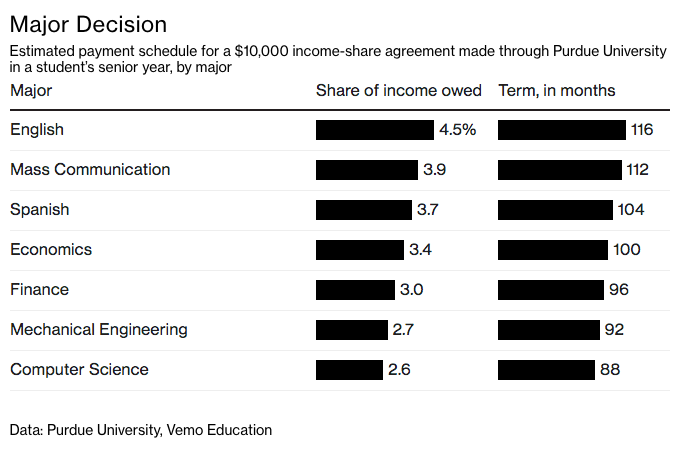
As Grit Post previously reported, Purdue University — Wroblewski’s alma mater — is one of approximately 30 schools allowing students to opt into (also called ISAs) as an alternative to taking on federal student loans from the Department of Education. The ISAs are managed by a company called Vemo Education, and income is either shared with the university itself, or with investors.
Hedge fund manager Chuck Trafton, who invests in ISAs, told Bloomberg that he viewed the $1.5 trillion student debt crisis as an opportunity for investors to make even more money, given the fact that the average college graduate is expected to make more than $1 million in lifetime earnings.
“I envision a whole new equity market for higher education in the next five years where today there’s only debt,” Trafton said.
Some presidential candidates, like Sens. Bernie Sanders (I-Vermont) and Elizabeth Warren (D-Massachusetts), have called for tuition-free, (or “debt-free,” in Warren’s case) public higher education as a means of alleviating the student debt crisis. South Bend, Indiana mayor Pete Buttigieg has merely and calling on states to cover a greater portion of public college tuition. But none of yet called for outright eliminating the $1.5 trillion in student debt — most of which is in federal loans.
As the Levy Institute of Economics at Bard College discovered in a 2018 study, buying up all student debt and erasing it would result in an economic stimulus of , as tens of millions of Americans would be freed from having to spend large portions of their monthly paychecks on paying student loan debt. And the cost would be as the Republican tax cuts of 2017.