(EDITOR’S NOTE, 4/30/19, 5:00 PM ET: This headline has been changed from “CNN and MSNBC Caught Manipulating Poll Numbers to Give Joe Biden Artificial Edge” to “Recent Poll Showing Biden in Lead Confuses and Distorts Support for Bernie Sanders” to more accurately reflect the CNN poll results and the information reported on by MSNBC. The CNN poll does not include data for specific demographics for Sanders, while the MSNBC graphic did not accurately reflect data from a separate poll. There is no evidence that suggests these were coordinated misinterpretations on the part of either network. We apologize to our readers for the confusion.)
Older respondents were over-represented, and younger voters were under-represented in a recent CNN/SSRS poll gauging support among the 2020 Democratic field of presidential candidates.
In the poll released April 30, Biden is shown with an impressive 24-point edge over Sanders, with 39% of voters saying they supported him, compared to just 15% for the Vermont senator. However, a Grit Post analysis of the results found that the poll largely excluded voters under the age of 50 in coming to that conclusion.
Also, the poll didn’t give respondents the option to offer their approval or disapproval of Sen. Sanders, even though the poll did ask respondents to give their approval or disapproval of lesser-known candidates like Reps. Seth Moulton (D-Massachusetts), Tim Ryan (D-Ohio), and Eric Swalwell (D-California), and even Miramar, Florida mayor Wayne Messam.
“We’d like to get your overall opinion of some people in the news. As I read each name, please say if you have a favorable or unfavorable opinion of these people – or if you have never heard of them. How about Joe Biden?” the poll asked. “How about Pete Buttigieg? … How about Kirsten Gillibrand? … How about Tim Ryan? … How about Eric Swalwell? … How about Seth Moulton?”
The phrase “How about Bernie Sanders?” does not appear in the poll.
In the overall breakdown of how the CNN/SSRS poll arrived at the conclusion that Biden had 39% support to Sanders’ 15%, the age breakdown of respondents shows that the only data available was for ages 50 to 65+. The columns for ages 18-34 and 35-49 all read “N/A,” meaning there weren’t at least 125 people who were part of those age groups participating in the poll to provide an adequate enough representation of the greater U.S. population.
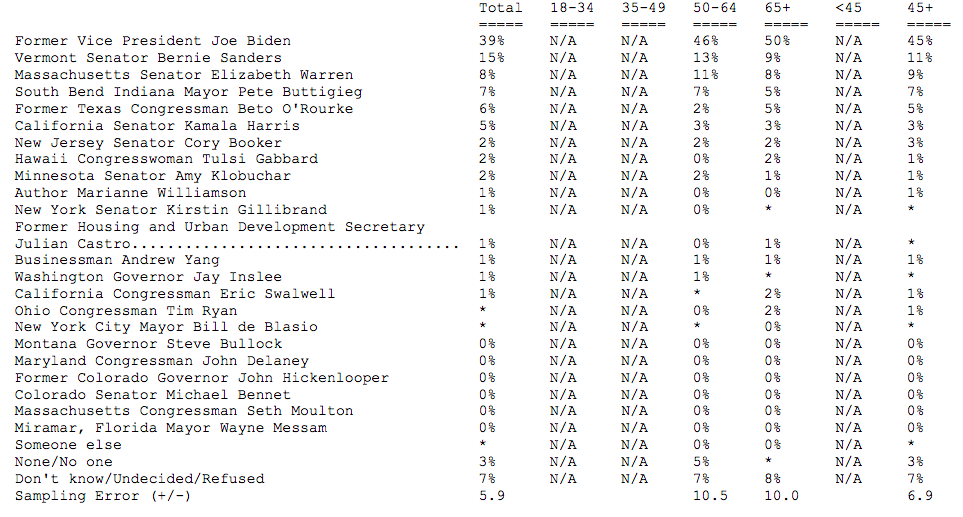
Confusingly, age breakdowns were included in the “how about” questions, but since respondents were not asked about Sanders in the “how about” section, his support amongst the 18-34 and 35-49 age demographics in that part of the survey was not revealed. In 2016, Sanders’ base was overwhelmingly made up of millennials and Gen-Xers. According to The Economist, in the 2016 Democratic primaries and caucuses, and that number was even higher in some states. Despite losing the Pennsylvania primary, Sanders won 83% of voters under 30.
However, this wasn’t the only poll that was misrepresented. Recently, MSNBC inaccurately reported on a Monmouth poll in a graphic showing support for leading Democratic candidates among non-white voters. In the poll conducted between April 11 and April 15, over Biden, with 27% of respondents saying they would vote for the Vermont senator, compared to just 25% of non-white voters saying they would vote for the former vice president.
However, as Twitter user @spittingback discovered, an MSNBC graphic describing that very same Monmouth poll showed Biden leading Sanders among non-white voters by a margin of 28% to 27%.
Hey – what's going on with this graphic? Did you just decide to give an extra 3 points in the poll?
— Ԍεοϝϝ🌹 (@SpittingBack)
As Grit Post has previously written, polls conducted this early are often not good predictors of how the election will turn out. However, it’s important to take note of when poll numbers are misrepresented. Especially when a leading candidate like Sanders is excluded from key questions, or when people under 50 aren’t adequately represented — particularly if those voters are expected to be one of, if not the largest voting blocs in 2020.