Rep. Richard Neal (D-Massachusetts), who has received more than $2 million from health insurers, will soon chair the committee that decides whether or not Medicare for All gets a vote.
Richard Neal is, according to the Center for Responsive Politics, the #1 all-time recipient of campaign donations from the insurance industry (which includes health insurers) who is still in Congress. Neal is only behind six others who have received more since 1990 — Hillary Clinton, Barack Obama, John McCain, Chris Dodd, Paul Ryan, and John Boehner.
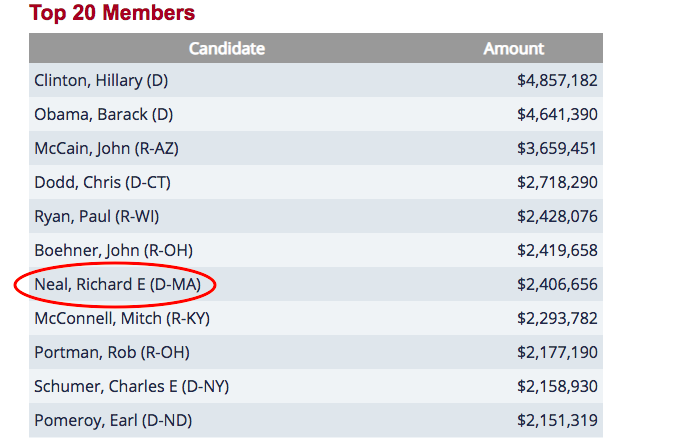
Because committee assignments are typically decided by seniority, Rep. Neal — who is currently the ranking member on the House Ways and Means Committee — is expected to become chairman of the committee once the Democratic majority in the House of Representatives is sworn in this coming January. As chair of the committee, Neal will be the ultimate decider of what bills get brought up for a vote in the committee, and which bills will die via pocket veto.
This could prove problematic for the Medicare for All movement, which will need to have a bill passed through Rep. Neal’s committee as such a proposal would require new taxes — which Neal’s committee oversees. A recent report from Sludge, which covers money in politics, explored Neal’s reticence toward accepting Medicare for All despite its popularity among both Democrats and Republicans.
In August, Neal said he didn’t think universal health care is a “realistic” goal for the incoming Congress and instead endorsed incremental change of the health care system. In , Neal said that people calling for a single-payer system would never be satisfied and needed to calm down. Protecting the Affordable Care Act, the congressman said, should be the priority—universal health care can wait.
“I think that there is an approach that is a little more incremental in nature,” said Neal.
The fact that Neal made those comments in opposition to Medicare for All in August is particularly noteworthy, as a Reuters survey of both Democratic and Republican voters from August fund that — including 51.9 percent of Republicans — were in favor of expanding Medicare to all Americans. Medicare for All is, oddly enough, actually more popular among Republican voters than with Senate Democrats.
Medicare for All’s popularity is likely due not only to its expansion of Medicare to Americans below retirement age, but also because it’s actually cheaper than our current healthcare system. In July, a conservative think tank found that while Senator Bernie Sanders’ (I-Vermont) Medicare for All bill would cost taxpayers $32 trillion over the course of a decade, it would still end up saving taxpayers $2 trillion compared to what Americans currently have. this savings comes from Americans no longer having to pay expensive premiums and deductibles associated with plans currently offered by private health insurers.
Rep. Neal may end up being pressured heavily from his Democratic colleagues to bring up the bill for a vote, despite what insurers may want. Particularly if Representative-elect Alexandria Ocasio-Cortez (D-New York), who ran on Medicare for All, gets the spot on the committee .